The Bikini Incision: Why Its Direction Matters
Published: Author: Mikheil Mikeladze, MD
The bikini incision is a variant of the anterior approach in which the skin is cut obliquely, along the natural crease of the groin, rather than vertically downwards. Choosing that direction has two practical reasons: a scar lying along the crease line is under less tension during movement and, at the same time, it hides under clothing. The direction of the incision does not change the operation itself, the implant or the way it is placed.
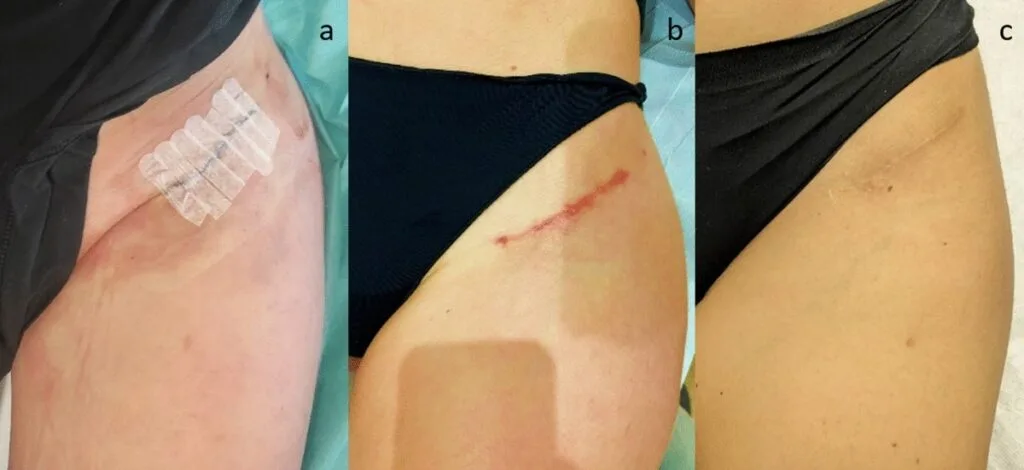
What the bikini incision is
The bikini incision is a skin cut that follows the line of the natural crease of the groin. The name comes from exactly that position: the incision lies on the line a swimming costume covers.
An important clarification: the bikini incision is not a separate approach. It is done within the anterior approach, meaning the route to the joint is the same, through the natural interval between two muscles. What differs is only how the skin is cut at the start of that route.
Deeper down the surgeon uses the same anatomical landmarks, works with the same instruments and places the same implant. The full description of the approach, with the protocol and the risks, is on the anterior approach page, and the comparison of approaches has a page of its own: anterior, lateral and posterior approach.
A note on terminology is worth adding. In the international literature this is called a bikini incision, or a direct anterior approach with bikini incision. In everyday conversation people often simply say “the bikini cut”. All three refer to the same thing and none of them changes the name of the approach.
Why the direction of the incision matters
The direction of the incision matters because skin has its own natural lines of tension. These lines are determined by the arrangement of the fibres beneath the skin and run in a particular direction in each region.
The practical rule is this: a cut that runs along these lines is under less tension while it heals. A cut that crosses them is, on the contrary, under constant tension during movement.
In the groin this matters particularly, because the joint moves and the skin is stretched with every step. A vertical incision crosses exactly the direction of that movement, while an oblique one follows it.
The third consideration is mechanical. In the crease of the groin the skin folds anyway when you sit. An incision that follows the crease moves as one when it folds; one that crosses the crease is stretched with every sitting and takes tension across it.
The second reason is an everyday one: an incision on the crease line hides under underwear and a swimming costume. This is not a medical argument, but for a patient it is often as important as the medical ones. The question is asked frequently in consultation and I consider it entirely legitimate: an operation is a return to a life, not only to a joint.
How it differs from the standard anterior incision
The bikini incision differs from the standard anterior incision only in the direction of the skin cut: deeper down the route, the implant and the way it is placed are the same.
| Feature | Standard anterior incision | Bikini incision |
|---|---|---|
| Direction | Vertical, downwards | Oblique, along the crease |
| Relation to skin lines | Crosses them | Follows them |
| Visibility under clothing | Often visible | Usually hidden |
| Route to the joint | Between muscles | Between muscles, the same |
| Implant and its placement | Unchanged | Unchanged |
| Technical demand | Lower | Higher |
The table shows the main point: the difference is at skin level and not at joint level. That is exactly why it is wrong to present the bikini incision as a different, better operation.
The technical demand needs explaining separately. From a vertical incision the instruments go straight towards the joint; from an oblique one they come in at a narrower angle. The surgeon has to work at angles and manage the view more carefully. This is not an obstacle provided the technique is well practised, but it is exactly why this incision is not used automatically everywhere.
The second technical detail concerns extension. If the view needs enlarging during the operation, extending a vertical incision is simpler. An oblique incision is less flexible in that respect, and this has to be assessed in advance, at the planning stage.
Does it change the result of the operation
The direction of the incision does not determine the main result of the operation. Joint function, pain relief and the service life of the prosthesis depend on correct implant position, restored leg length and stability of the joint.
The honest formulation is this: the bikini incision improves what happens at the skin and does not change what happens in the joint. Both matter, but confusing them creates a false expectation in the patient.
There is one practical nuance that deserves separate attention. A sensory skin nerve runs near the incision, and irritating it causes numbness or a burning sensation on the outer surface of the thigh. This does not affect muscle strength or walking and usually fades over time, though it can partly remain. I explain this to patients in advance.
The sensory skin nerve is responsible only for sensation and does not move any muscle. Irritating it does not mean the leg has “become weak” or that the joint is working badly: the person walks normally, climbs stairs and stands up, it is simply that sensation over one patch of skin is altered. Many patients no longer notice it after a few months.
It also matters that this feature belongs to the anterior approach in general and not specifically to the bikini incision. The nerve lies in the same place whatever the direction of the skin cut.
Who it suits and who it suits less
The bikini incision is technically more demanding, because from an oblique cut the route to the joint runs at a narrower angle. That is exactly why it is not the optimal choice in every case.
Factors that affect the decision:
- Body build. The volume of tissue under the skin and the position of the crease determine how technically comfortable this incision is.
- The state of the joint. Marked deformity or fusion may require the view to be extended.
- Previous surgery or injury. An existing scar and altered anatomy call for separate assessment.
- A repeat procedure. In a revision operation the priority is a wide view.
- The condition of the skin. Irritation or inflammation of the skin in the crease affects planning of the procedure.
The decision is made during preoperative assessment. In consultation I say directly if I think another option is safer in a particular case.
Separate attention goes to the state of the skin in the crease. If the skin there is constantly moist or irritated, the conditions for wound healing are worse. In that case getting the skin into better condition before surgery is set as a task of its own, or the site of the incision is reconsidered.
It also matters that this decision is made before the day of surgery and should not come as a surprise to the patient. If the anatomy is not suitable for a bikini incision, I say so in advance and explain which option has been planned and why.
What to know about scar healing
Scar healing is a staged process and its final appearance is not visible straight away. At first the scar is more noticeable, then it gradually fades and softens.
Practical recommendations usually given to patients:
- Wound care as instructed by the doctor. Using additional products on your own initiative is not recommended.
- Protection from the sun. A new scar pigments more easily in the sun.
- Avoiding waistbands and tight edges of clothing. Mechanical irritation slows healing.
- Watching for signs. Redness, swelling, warmth, discharge or fever are grounds for contacting the doctor immediately.
The scar gradually fades and softens; it takes its final form over months, and that process continues beyond the first year. The result is individual and depends on the properties of the skin too, so no promise about a specific appearance is made.
The properties of the skin are a factor in their own right, one that neither surgeon nor patient can influence. Some people develop a thicker and more noticeable scar, others one that stays almost invisible. If you have had a thick, raised scar after another operation or wound in the past, you should tell your surgeon in advance: that information affects planning.
Patients often ask about sutures. Several ways of closing a wound are in use today, and some of them use a thread that dissolves on its own and needs no removal. The specific option is a matter for the surgeon and the state of the wound, and it is discussed before the operation.
What a realistic expectation is
The realistic expectation is this: the incision usually hides under clothing, the scar fades over time, and none of this changes the result of the operation, for better or for worse.
A bikini incision is usually five to six centimetres, while the lateral approach uses nine to ten. The length is individual and depends on body build and the state of the joint. A short incision is not a goal in itself: the view matters more than a short cut, because the implant has to be placed correctly.
Recovery times depend mainly on the approach and the patient’s general condition, not on the direction of the skin cut. The stages are described day by day on the recovery page.
Something should be said here about what should not be the basis of a choice. The direction of the incision should not become the main criterion for choosing a surgeon. If you are choosing between two options, the first question should be which approach the surgeon knows well and how the operation is planned, and only then how the scar will look.
In my practice the bikini incision is the standard variant of the anterior approach where the anatomy allows it. Where it does not, I tell the patient in advance and explain why. That honest conversation before surgery is better than the disappointment that comes from a false expectation.
What to remember
- The bikini incision is a variant of the anterior approach and not a separate approach.
- The direction has a practical basis: a scar on the crease line is stretched less.
- The incision usually hides under clothing.
- The result of the operation is determined by implant position, not by the direction of the skin cut.
- Technically it is more demanding and does not suit every case.
Whether a bikini incision suits you is a question of your skin crease and your anatomy. At a consultation we will assess that together and I will tell you what is planned: book a consultation.
Common questions
Is the bikini incision only a matter of appearance?
Not only. The cosmetic side is real, but the direction has a practical basis as well: a scar running along the skin crease is under less tension during movement. Beyond that, the crease line leaves the incision hidden under clothing, which matters to many patients.
Does the bikini incision reduce the risks of the operation?
The direction of the skin cut does not change the main risks of the operation. Those depend on the approach, the surgeon experience, correct implant position and the patient condition. The bikini incision is a decision at skin level, not at joint level.
Can anyone have a bikini incision?
No. It is technically more demanding and does not suit every anatomy. Body build, the position of the skin crease, the state of the joint and whether the view may need extending during surgery all matter. The decision is made during preoperative assessment.
What should I expect the scar to look like?
The scar is more noticeable at first and fades and softens over time. It takes its final form over months, and that process continues beyond the first year. The result is individual and depends on the properties of the skin too, so no promise about a specific appearance is made.
This text is educational and does not replace a consultation. A diagnosis and a treatment plan can only be set after a personal examination.
Have a question about your own case?
At the consultation we look at your X-ray together and I tell you what stage the joint is at and what the next step is. Seeing a surgeon does not mean surgery.
More in short videos: follow me
Read next
- Anterior approachAnterior, Lateral and Posterior Approach: How They DifferThe lateral approach is the most widely used in Georgia. How it differs from the anterior and posterior approaches and what each of them involves.
- Making the decisionWhen the Time for a Hip Replacement Arrives: Signs Worth WeighingThe time for surgery arrives when pain is changing daily life and conservative treatment has run out of room. The X-ray is not what decides it.
- Injection therapyHyaluronic acid injections in the knee: who they help and for how longA hyaluronic acid injection temporarily improves the properties of joint fluid and reduces pain in osteoarthritis. Who it helps, how long the effect lasts and what it cannot do.
