Injection Therapy for Hip Osteoarthritis: A Realistic Expectation
Published: Author: Mikheil Mikeladze, MD
Injection therapy for hip osteoarthritis eases pain temporarily and makes movement easier, but it does not restore worn cartilage. Its real task is to buy time and to make it possible for the patient to carry out the other steps of non-surgical treatment better. An injection is part of the programme, not a substitute for it.
What injection therapy is and how it is done
Injection therapy means delivering a drug directly into the joint cavity so that it acts where the problem is, rather than across the whole body. In the case of the hip, the procedure has one important particularity.
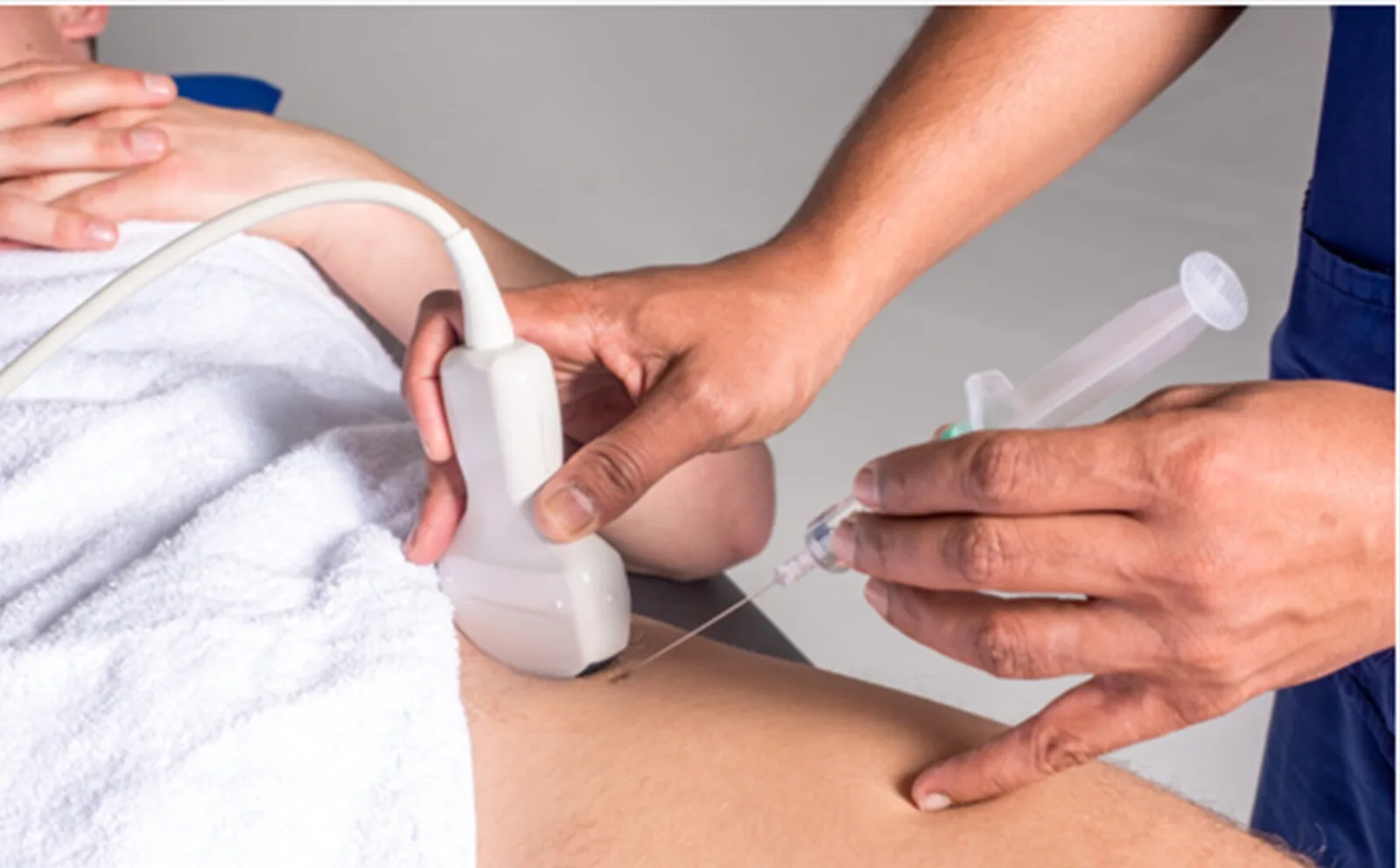
Unlike the knee, the hip joint lies deep in the body and cannot be felt with the hand. So an injection is only done under imaging guidance: with ultrasound or under X-ray control. Without guidance, getting the needle into the joint is not reliable and the drug may end up around the joint instead.
The procedure is an outpatient one and is usually done under local anaesthetic. Afterwards the patient goes home the same day, with a recommendation to limit load temporarily.
Local discomfort or a temporary increase in pain is possible in the first days after an injection. This usually settles on its own. The signs that call for contacting the doctor immediately are different: marked swelling of the joint, fever, redness of the skin, or pain that grows day by day.
It also matters that an injection follows a diagnosis rather than replacing one. Before we discuss the procedure we need to know what is happening in the joint and where the pain comes from. The logic of assessing the joint is described on the hip arthritis page.
What hyaluronic acid achieves
Hyaluronic acid is a substance that is a natural component of healthy joint fluid, giving it its slipperiness and its ability to absorb shock. In osteoarthritis the properties of the joint fluid deteriorate, and the idea of the injection is precisely to improve those properties temporarily.
The realistic expectation is this: a reduction in pain and easier movement for a certain period are possible. The effect lasts seven to eight months on average, and the exact duration depends on the stage of the joint.
Hyaluronic acid does not grow cartilage and does not widen the joint space. Its effect is symptomatic and temporary. At a late stage, when the joint space is practically gone, the expected result is usually smaller.
Preparations differ in molecule size and concentration, which determines whether a single injection is given or a course. I deliberately do not name a specific product in this text: the choice is individual and is made by the doctor according to the state of the joint.
The effect is not judged on the day after the procedure. With hyaluronic acid the change usually appears gradually, so a conclusion is worth drawing after a few weeks. Keeping a record is useful too: what has changed in walking distance, in sleep at night and in the need for painkillers.
What PRP achieves
PRP, or platelet-rich plasma, is a preparation made from the patient’s own blood in which the concentration of platelets is increased. Platelets contain substances that take part in tissue healing.
The procedure has two stages: blood is taken, then processed in a centrifuge, and the resulting plasma is injected into the joint. Because the preparation is made from the patient’s own blood, there is no risk of a reaction to a foreign substance.
The honest answer about PRP is this: in short-term results PRP is roughly equivalent to hyaluronic acid. Most studies show no difference in functional scores, while post-injection pain is more common after PRP. There is less research for the hip than for the knee, and protocols are not standardised between clinics. PRP does not deliver restoration of cartilage.
The difference lies in how the preparation is made: the method, the centrifugation settings and the final composition do not match between clinics. This makes studies hard to compare with one another and partly explains why the results are so inconsistent.
The practical position is this: PRP may be considered once other conservative measures have been used and the patient shares a realistic expectation. It should not be the first step, and it should not be presented as an alternative to surgery when the joint is already significantly damaged.
What a steroid injection does
A corticosteroid injection has a powerful anti-inflammatory action and usually reduces pain quickly. Speed and the strength of the effect are its main advantages.
It has two important limits. First: the effect is temporary and frequent repetition carries its own risks. Second, and critical for planning surgery: a steroid injection shortly before a hip replacement is considered from the point of view of infection risk.
There is one practical conclusion. If surgery is on the agenda or may come onto it in the near future, the doctor has to be told before the injection. The interval between an injection and a hip replacement should be at least three months.
A steroid injection has one further consideration: in patients with diabetes it temporarily raises blood glucose. This is not a contraindication, but it calls for a warning and for monitoring in the first days after the procedure.
My position is this: a steroid injection is a useful tool when a flare needs settling quickly or when pain has to be controlled for a specific, time-limited purpose. It is not a long-term strategy, and repeating it often does not solve the problem.
How the three methods differ
Hyaluronic acid, PRP and corticosteroid differ in how they are meant to work and in the result to expect, although all three work on the symptom and none restores cartilage.
| Method | The idea behind it | What it achieves | What it does not achieve |
|---|---|---|---|
| Hyaluronic acid | Improving the properties of joint fluid | Less pain, easier movement | Does not restore cartilage |
| PRP | Stimulating tissue healing processes | Symptom relief in some patients | Does not restore cartilage |
| Corticosteroid | Powerful suppression of inflammation | Rapid reduction in pain | Does not halt the process |
All three work on the symptom. That does not diminish their value, but it does define what to expect from them.
Who it suits and who it suits less
Injection therapy makes more sense when the osteoarthritis is at an early or middle stage, pain is getting in the way of exercise, and the other steps of treatment are already working.
A significant result is less likely in these situations:
- when the joint space is practically gone and bone touches bone;
- when the shape of the femoral head has changed significantly;
- when restricted movement is more of a problem than pain;
- when the main source of pain is outside the joint, for instance in the lower back.
An injection is also not advisable if there is an inflammatory process in the skin or around the joint, or if the patient has a condition that increases the risk of infection. These matters are assessed individually.
Avascular necrosis of the femoral head, meaning the death of bone cells because of a disturbed blood supply, is a separate situation. Here the problem is inside the bone and not in the joint fluid, so injection therapy does not give the expected result. The logic and the timescale are different.
A common expectation also needs correcting: an injection is not a way of postponing surgery once the joint is exhausted. In that case it only eats up time, and the pain soon returns. So the decision about the procedure is made after assessing the image and the clinical picture together.
Where an injection sits in the whole plan
An injection is one step in a full programme, not a substitute for it. If pain falls after an injection, that is exactly the moment when exercise and weight control work most effectively: the joint hurts less and load is easier to tolerate.
The common mistake is that during the period of relief the patient stops doing everything else. Once the effect wears off, the situation returns to the same point or worse, because during that time the muscle was not strengthened and the load was not reduced. The full logic of non-surgical treatment is in a text of its own: non-surgical treatment of hip osteoarthritis.
The result of an injection also gives diagnostic information. If a drug injected into the joint significantly reduces the pain, that confirms the source of the pain really is the joint and not something outside it. This information is useful when the question of surgery is being discussed too: when the time for an operation arrives.
It works the other way as well: if a drug injected into the joint had practically no effect on the pain, that is a serious hint that the main source of the complaint lies outside the joint. In that case the lower back, the state of the tendons and bursae and other possible causes need reviewing. This information is particularly valuable before surgery, because replacing a joint cannot remove pain that does not come from the joint.
The full range of treatment, from conservative to surgical, is described on the treatment page.
The practical sequence I suggest in consultation is this:
- The diagnosis first. We have to know where the source of the pain is and what stage the joint is at.
- Then the basic steps. Weight control, load management and exercise start before an injection, not instead of it.
- An injection if pain is getting in the way of those steps. That is its main, justified role.
- Judging the result by specific measures. Walking distance, sleep at night, the need for painkillers.
- A decision about the next step. Repeat, another method, or a conversation about the surgical option.
The question of cost should be discussed honestly too. Injection therapy, particularly as a course, involves expense, while the effect is temporary. When a patient has already had several courses and the relief is getting shorter each time, that in itself is a signal that the conversation should continue in another direction.
What to remember
- Injection therapy works on the symptom and does not restore cartilage.
- An injection into the hip is only done under imaging guidance.
- How long the effect lasts is individual and is usually shorter at a late stage.
- A steroid injection is a special case and has to be coordinated with the timing of surgery.
- The period of relief after an injection should be used for exercise, not for a break.
The decision about an injection is made after assessing the image and the complaint together. At a consultation we will discuss honestly what it would give you in your case: book a consultation.
Common questions
Do injections restore cartilage?
No. The injection methods available today do not restore worn cartilage and do not widen the joint space. Their real task is to ease the symptom and make movement easier. That is a valuable task, but it is not a cure, and a promise of one deserves caution.
Why is the injection done under imaging guidance?
The hip joint lies deep in the body, under a thick layer of muscle, and cannot be felt with the hand. Without ultrasound or X-ray guidance, getting the needle into the right place is not reliable. Guidance ensures the drug reaches the joint and not the tissue around it.
How often can an injection be repeated?
The number and the interval depend on the type of drug and on the patient. Steroid injections have their own limits on frequent repetition. The decision is individual and is made by the doctor after assessing the result and duration of the previous injection.
If I am planning surgery, can I have an injection?
This has to be agreed with your surgeon in advance. A steroid injection shortly before a hip replacement is considered from the point of view of infection risk, and the interval between injection and surgery should be at least three months. So always mention it before an injection if an operation is on the agenda.
This text is educational and does not replace a consultation. A diagnosis and a treatment plan can only be set after a personal examination.
Have a question about your own case?
At the consultation we look at your X-ray together and I tell you what stage the joint is at and what the next step is. Seeing a surgeon does not mean surgery.
More in short videos: follow me
Read next
- Hip arthritisNon-surgical Treatment of Hip Osteoarthritis: What It Can and Cannot DoNon-surgical treatment controls pain and preserves the function of the hip, but it does not restore cartilage. A realistic expectation is part of the treatment.
- Non-surgical treatmentSeeing an orthopaedic trauma surgeon: which symptoms warrant a visitAn orthopaedic trauma surgeon treats joint, bone and muscle problems. Which symptoms warrant a visit, what a consultation covers and when not to wait.
- Making the decisionWhen the Time for a Hip Replacement Arrives: Signs Worth WeighingThe time for surgery arrives when pain is changing daily life and conservative treatment has run out of room. The X-ray is not what decides it.
