The Hip Implant: What It Is Made Of and How the New Joint Works
Published: Author: Mikheil Mikeladze, MD
A hip implant is an artificial joint that replaces the damaged surfaces of the hip. It has four main parts: a cup set into the pelvis, a liner placed inside it, a spherical head, and a stem set into the femur. This construction reproduces the mechanical principle of the natural joint: a spherical surface turning in a hollow one, with minimal friction.
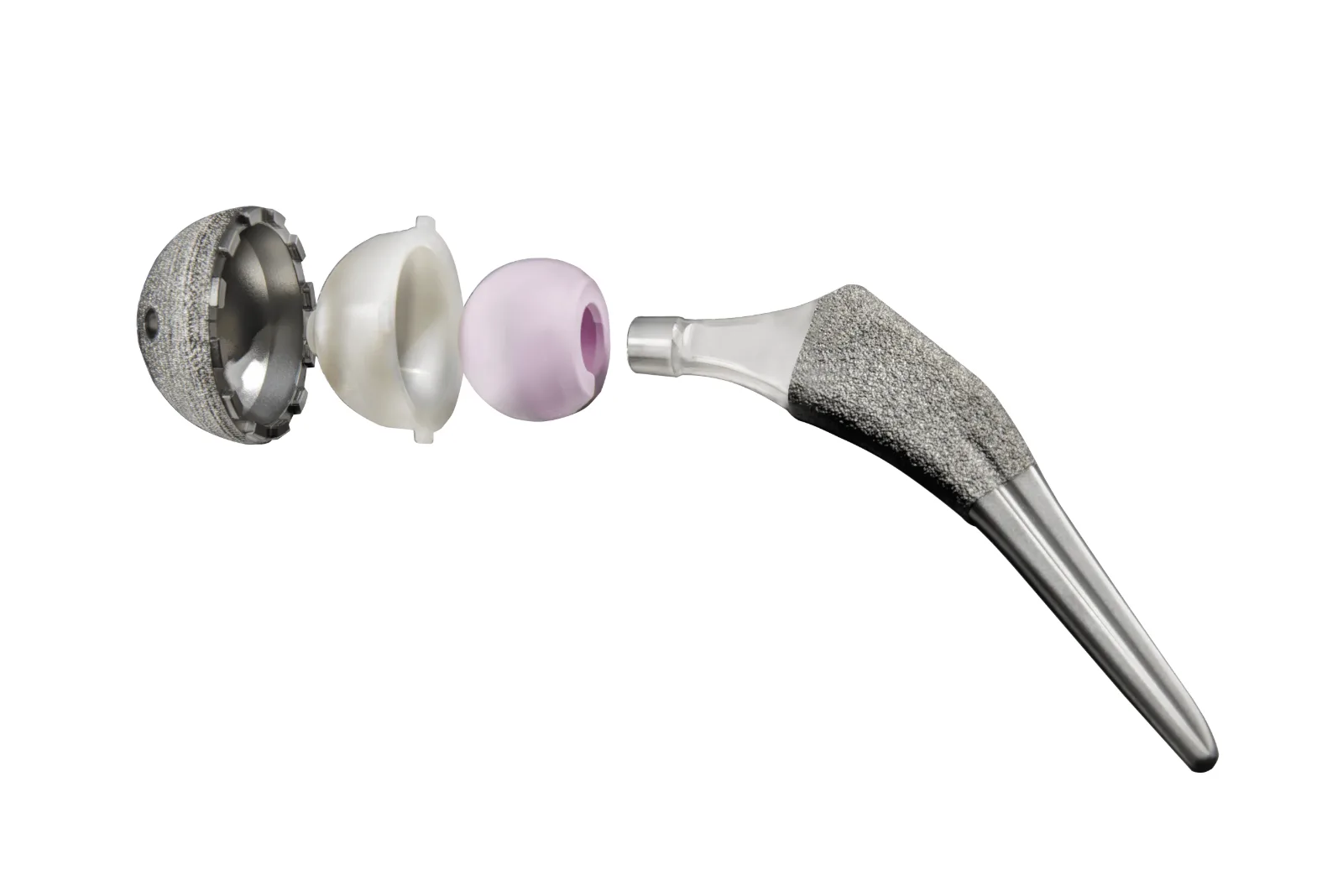
What a hip implant is
A hip replacement is an operation in which the damaged surfaces of the joint are replaced with artificial parts. An important clarification: neither the whole joint nor the whole bone is replaced. What is replaced are the surfaces where the cartilage has worn away.
In the natural joint the spherical head of the femur sits in the acetabulum of the pelvis. Both surfaces are covered by cartilage, and that is what provides the glide. In osteoarthritis the cartilage thins, the joint space narrows and bone touches bone.
The implant replaces those two surfaces. A cup is placed where the acetabulum was, and an artificial spherical head where the femoral head was. The glide is restored and the mechanical cause of the pain disappears.
The aim of the operation is not a new leg. The aim is to remove the pain and restore movement. The full description of joint replacement, with approaches and the protocol, is on the anterior approach page.
What the implant is made up of
The implant has four main parts and each has a specific function.
| Part | Where it is placed | Function |
|---|---|---|
| Cup | In the acetabulum | Replaces the damaged surface of the socket |
| Liner | Inside the cup | Creates the sliding surface the head turns on |
| Head | On the top of the stem | Replaces the damaged femoral head |
| Stem | Inside the femur | Anchors the construction to the bone |
All four parts exist in various sizes and fit together like the elements of a system. That is what makes it possible for an implant to be matched to a particular patient’s anatomy.
Dividing it into parts has a practical point too. If a repeat procedure becomes necessary years later because of wear, it is often enough to change only the liner and the head, while the stem and the cup stay in place. That is a far simpler operation than replacing the whole construction.
The length of the stem, the diameter of the head and the length of the neck together determine leg length and the stability of the joint. This is why choosing the sizes is one of the most important stages of the operation.
The parts are not placed all at once. First the acetabulum is prepared and the cup is placed, then the inner canal of the femur is prepared and the stem is inserted, and finally the head is fitted onto the stem and the joint is put back in place. At each stage the surgeon checks the position and the range of motion.
Trial components deserve separate attention. Before the final implant goes in, temporary trial components are used to check leg length, joint stability and range of motion. Only then are the final parts placed. This stage is invisible to the patient, but it is exactly what determines the final result.
What the bearing couple means
The bearing couple is the two surfaces that slide against each other: the spherical head and the liner in the cup. It is the combination of these two materials that determines how slowly the implant wears over the years.
Several combinations are in use today. The most common is a metal or ceramic head with a specialised polyethylene liner. Ceramic on ceramic is also used. Each option has its own strengths and its own points to consider.
Factors affecting the choice:
- Age. For a younger patient wear resistance matters more, because the implant will have to work for longer.
- Activity level. More load means more wear.
- Bone quality and anatomy. These determine which sizes and configurations are possible.
The diameter of the head matters too. The sizes most often used are twenty-eight, thirty-two and thirty-six millimetres. A larger head makes the joint more stable and reduces the risk of dislocation, but in exchange it thins the wall of the liner, which affects long-term wear. The choice depends on the size of the acetabulum: the socket determines the size of the cup, and the cup determines how large a head will fit.
Wear does not disappear entirely in any combination. Friction releases microscopic particles, and it is the body’s reaction to those particles that is one of the reasons an implant can loosen over time. Modern materials are aimed precisely at slowing that process.
Patients often ask what the choice costs them. The answer is this: the surgeon chooses the bearing couple according to age, activity and anatomy, while the patient’s part is to tell the surgeon honestly what activity they do and what they plan after the operation. That information directly affects the choice.
How the implant is fixed to the bone
An implant is fixed to bone by one of two principles: with bone cement, or cementless, meaning the bone itself grows into the porous surface of the implant.
Cemented fixation gives solid attachment immediately. Cementless fixation relies at first on precise, tight insertion of the implant, after which the bone gradually grows into its surface and the attachment becomes biological.
Both principles are widely used and both have good results. The choice depends on the patient’s age, bone quality and anatomy. I have discussed the subject in a text of its own: cemented and cementless fixation.
A hybrid version is also often used, where one part is cemented and the other is not. This is not a compromise: it is a decision taken separately for each part.
How size and position are chosen
Size and position are planned before the operation, on the basis of an X-ray. This stage is called preoperative planning, or templating.
Planning covers:
- Calculating the sizes. With the help of an object of known size on the image, the likely sizes of cup, stem and head are determined.
- Defining the centre of rotation. The point around which the joint turns has to be restored close to the natural one.
- Planning leg length. The length of both legs should match.
- Allowing for alternatives. The plan includes what happens if the anatomy turns out to differ from expectations.
The plan is checked during the operation. With the anterior approach, with the patient lying on their back, X-ray guidance is possible and the length of both legs can be compared directly as the operation proceeds.
The plan and the final size do not always match exactly, and that is normal. The image is two-dimensional while the bone is three-dimensional, so several neighbouring sizes are always prepared in theatre. That is exactly why preoperative planning counts as a guide and not as a final decision.
Restoring the centre of rotation is a task in its own right. If it is placed close to its natural position, the muscles work at the right tension and the joint is stable. If not, the result can be a limp or a difference in leg length, even if the implant itself is sound.
What the implant does and does not do
The implant removes the pain that comes from the damaged surfaces of the joint and restores the range of motion. Those are its two main tasks.
What the implant does not do:
- It does not cure the joint. It replaces the surfaces; it does not restore cartilage.
- It does not remove pain that does not come from the joint. A problem in the lower back or a tendon stays where it is.
- It does not strengthen muscle. That is the task of rehabilitation.
- It is not permanent. An implant has a service life: how long a hip implant lasts.
The honest formulation is this: an implant solves a mechanical problem by mechanical means. That is exactly why it is important before surgery to be sure the source of the pain really is the joint.
This clarification has a practical consequence. If a patient has a problem in the lower back alongside hip osteoarthritis, the pain coming from the joint usually disappears after the operation while the back pain remains. If that has not been discussed in advance, the result feels like a disappointment, although in reality the operation did its job. So in consultation I always try to separate out which complaint comes from which source.
What a patient feels with a new joint
Most patients do not feel the implant separately in daily life. Walking, sitting, climbing stairs and getting into a car usually become automatic over time.
Unusual sensations are possible in the early period: a feeling of heaviness around the thigh, muscle fatigue and, in some cases, a slight noise on movement. These usually fade gradually.
Practical details people often ask about: an implant may be detected by a metal detector, so a note from the doctor is useful when travelling. Magnetic resonance imaging is a separate question and your doctor should be told in advance.
Dental and other procedures are a separate question. An implant in the body is susceptible to infection, so you should tell any doctor or dentist that you have one before any procedure. The specific recommendations are individual and are set by your doctor.
It also matters that getting used to an implant takes time. For years the brain was accustomed to a painful joint and an altered gait. Learning the new, painless movement happens gradually, and that is exactly why rehabilitation is a full part of the operation rather than an addition to it.
The stages of recovery, with timescales and restrictions, are described on the recovery page.
What to remember
- A hip implant replaces the damaged surfaces of the joint, not the whole joint.
- It has four parts: cup, liner, head and stem.
- The bearing couple determines how slowly the implant wears.
- Size and position are planned before surgery and checked during it.
- The implant removes pain, but it does not cure the joint and it is not permanent.
The size and position of an implant are planned separately for each patient. At a consultation we will look at your images together and I will show you what would be planned in your case: book a consultation.
Common questions
Does a hip implant reproduce the natural joint?
The implant reproduces the mechanical principle of the natural joint: a spherical head turns in a cup, just as the femoral head turns in the acetabulum. It is not living tissue and does not heal itself, so talking about complete equivalence is inaccurate. Functionally most patients do not feel the difference in daily life.
What is the implant made of?
The main parts are made of medical alloys, ceramic and a specialised polyethylene. The materials are chosen for wear resistance and compatibility with the body. The specific combination depends on the patient age, activity level and bone quality.
Can you feel the implant in your body?
Most patients do not feel the implant separately in daily life. Unusual sensations and a feeling of heaviness around the thigh are possible in the early period and usually fade over time. An implant may be detected by a metal detector.
Is the same implant used on both sides?
Not necessarily. The size and configuration are planned separately for each side, because the anatomy is not identical on both. If one joint has already been replaced, equal leg length is a separate task to consider when planning the second.
This text is educational and does not replace a consultation. A diagnosis and a treatment plan can only be set after a personal examination.
Have a question about your own case?
At the consultation we look at your X-ray together and I tell you what stage the joint is at and what the next step is. Seeing a surgeon does not mean surgery.
More in short videos: follow me
Read next
- Anterior approachThe Bikini Incision: Why Its Direction MattersThe bikini incision is a variant of the anterior approach where the cut follows the natural skin crease. Direction affects scar tension and how visible it is.
- Anterior approachAnterior, Lateral and Posterior Approach: How They DifferThe lateral approach is the most widely used in Georgia. How it differs from the anterior and posterior approaches and what each of them involves.
- Making the decisionWhen the Time for a Hip Replacement Arrives: Signs Worth WeighingThe time for surgery arrives when pain is changing daily life and conservative treatment has run out of room. The X-ray is not what decides it.
