The Early Signs of Hip Osteoarthritis That People Overlook
Published: Author: Mikheil Mikeladze, MD
The first signs of hip osteoarthritis rarely begin with severe pain. What usually comes first is stiffness in the groin in the morning, difficulty putting on socks or tying shoelaces, and a change in gait that nobody notices. This is exactly why people see a doctor late: the signs get put down to age, tiredness or a back problem.
What is hip osteoarthritis
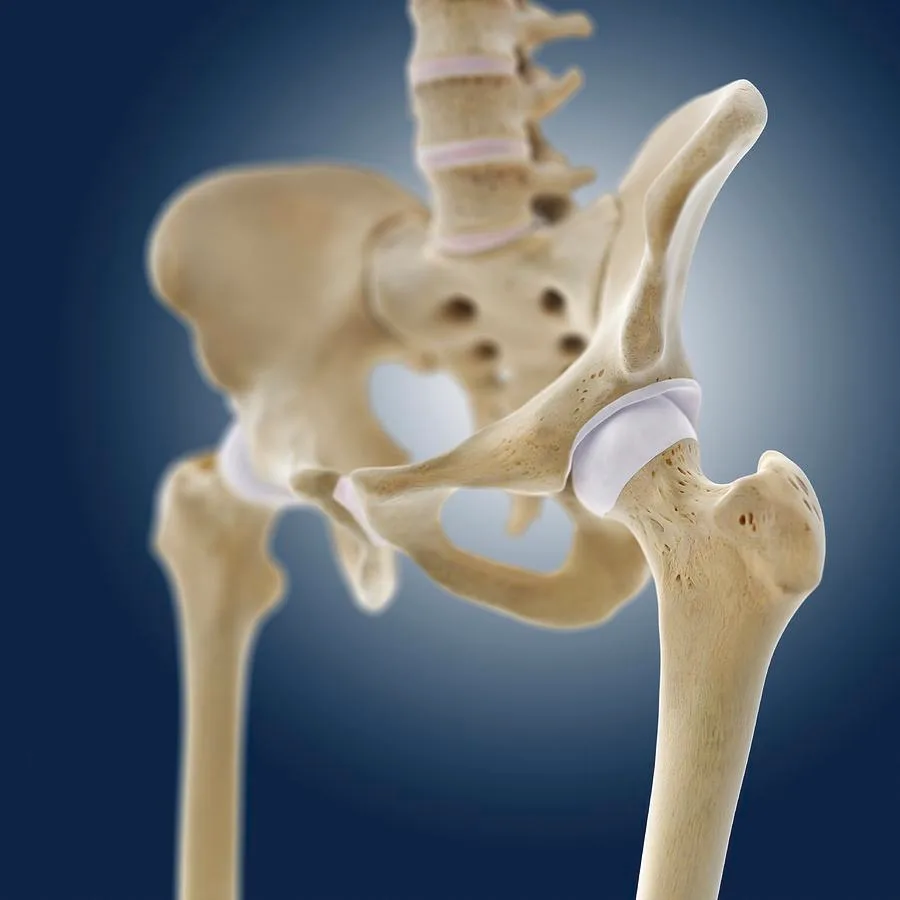
Hip osteoarthritis, also called coxarthrosis, is the gradual wearing away of the cartilage in the joint, followed by pain, restricted movement and a change in gait. Cartilage is the smooth, slippery layer that covers the femoral head and the acetabulum and lets them move against each other with almost no friction.
The hip is a ball-and-socket joint: the round head of the femur sits in the socket of the pelvis like a ball in a cup. That shape allows movement in every direction and, at the same time, carries the weight of the body with every step.
Cartilage has no nerve endings. That is precisely why the beginning of the wear is painless and the person feels nothing. Pain appears once the joint capsule, the bone surface and the lining of the joint are drawn in. This is the main reason hip osteoarthritis is so often recognised late.
The process moves in one direction. First the cartilage thins and loses its glide, then the distance between the femoral head and the socket shrinks, which on an X-ray is called joint space narrowing. Bone left without the protection of cartilage responds with hardening, known as subchondral sclerosis, and with bony outgrowths called osteophytes. The joint capsule thickens and movement is gradually restricted.
Hip osteoarthritis can develop on its own, against a background of years of loading and age, or as a result of another cause. In the second case it comes from a hip that did not develop fully in childhood, an old injury, or a disturbance in the blood supply to the femoral head. The cause matters, because it decides how quickly the process moves and how soon a decision is worth making.
The anatomy of the joint, the causes and the stages are set out in full on the hip arthritis page.
What are the first signs of hip osteoarthritis
The first signs of hip osteoarthritis are more often functional than painful: a person can no longer do something they used to do without thinking. Pain is usually what gets added afterwards.
These are the signs I hear most often in consultation:
- Stiffness in the morning or after sitting for a long time. The joint needs “warming up”: the first few steps are heavy, then it eases.
- Putting on socks and tying shoelaces. Bending the leg and taking it out to the side is difficult; people rest the foot on a chair or ask someone for help.
- Getting out of a car and climbing a high step. Both movements ask for deep flexion of the hip.
- Pain in the first steps. The pain arrives the moment you stand up and fades a few minutes after you start walking.
- Restricted internal rotation of the leg. This is one of the earliest objective signs a doctor picks up on examination.
- A shorter walking distance. A person no longer covers the distance they walked every day eighteen months ago.
- Night pain when lying on that side. This is a later sign and usually means the process has moved on.
One sign does not make a diagnosis. What matters is the combination, and the fact that they build up gradually over months.
A shrinking range of motion is the thing most often missed. People notice pain, whereas the leg no longer turning the way it used to happens slowly and becomes obvious only when it blocks a specific task: cutting toenails, getting into the bath, or sitting down in a car.
Why these signs go unnoticed
The signs stay below the radar because hip osteoarthritis develops slowly and the body adapts to it without announcing anything. A person changes their gait, changes how they sit and changes their habits without registering any of it.
The four most common reasons:
- The signs get put down to age. “At my age this is normal” is the phrase I hear most often in consultation. Age is a risk factor for osteoarthritis, but pain is not a normal part of getting older.
- The pain is felt away from the joint. Groin or knee pain is rarely associated with the hip.
- The body compensates. The lower back, the knee and the other leg take on part of the load. As a result the complaint may shift to the back, and treatment may start there.
- The pain comes in waves. A good spell creates the impression that the problem has passed, while the change inside the joint carries on in the same direction.
Delay has a price. A long-standing limp and avoiding load weaken the thigh muscles, above all the gluteal muscle that stabilises the hip during walking. A weak muscle increases the load on the joint and the circle closes. On top of that, a hip held in a bent position for years loses its ability to extend, and that restriction is slower to come back afterwards.
Where the pain really is: groin, buttock or knee
Hip pain most often appears in the groin, not on the outer surface of the hip. It can run down the front of the thigh and reach as far as the knee.
Pain referred to the knee deserves separate attention. The hip joint and the front of the knee share nerve pathways, so a signal from the hip can be read by the brain as knee pain. In my consultations I regularly meet a patient who was treated for a knee for months while the problem was in the hip.
Pain on the outer side of the hip, over the bony prominence, is more often linked to something else, such as an irritated tendon or bursa. That does not rule out osteoarthritis, but it is not the typical picture. Telling it apart from an inflammatory process has a text of its own: osteoarthritis or arthritis: the difference between the two diagnoses.
Where the pain sits and what causes it has a text of its own: why the groin hurts and not the hip.
How osteoarthritis pain differs from muscle pain
Osteoarthritis pain is mechanical: it builds with load and eases with rest. A muscle or tendon problem usually gives a different picture, although both can be present at once.
| Sign | Hip osteoarthritis | Muscle or tendon problem |
|---|---|---|
| Onset | Slow, over months or years | Often from a particular day or after a specific load |
| Location | Groin, front of the thigh, sometimes the knee | A specific point that is tender to touch |
| Load | Builds with walking, eases with rest | Often tied to one particular movement |
| Morning stiffness | Present and short, clears once you start moving | Usually absent |
| Range of motion | Shrinks, internal rotation first | Usually preserved |
| Night pain | Appears at a later stage | Rare |
The table is a guide and does not replace a diagnosis. The final answer comes from examination and an X-ray.
Which sign is worth seeing a doctor for
If groin pain or stiffness in the hip lasts longer than a week and does not settle on its own, an assessment is already justified.
These deserve separate attention:
- a limp while walking that other people notice before you do;
- growing difficulty putting on socks or bending the leg;
- pain that wakes you at night;
- a complaint that does not respond to treatment of the back or the knee;
- a noticeable drop in walking distance over the last few months.
One situation is worth naming on its own: if groin pain becomes suddenly and rapidly worse, particularly against a background of long-term steroid use or an injury, the assessment cannot wait. In that case avascular necrosis of the femoral head is considered, which follows a different logic and sets a different timescale.
What happens at the first consultation
The first consultation is there to confirm the diagnosis and decide the next step. At BAU International Hospital in Batumi it usually has four parts:
- The conversation. When it started, where it hurts, what makes it worse and what eases it, what has changed in daily life. Concrete examples matter: how long you can walk without stopping, whether you sleep through the night, which task is hardest.
- The examination. I check the range of motion, above all internal rotation, which is restricted earliest. I watch how you walk, check how far the hip extends and measure leg lengths.
- The X-ray. The width of the joint space, changes in bone density and osteophytes together show what stage the process has reached. The image is taken standing, because under load the joint space shows its real width. Further imaging is added if needed.
- The explanation and the plan. We look at the image together, then work out what the next step is and when it is worth reviewing.
One thing should be said here: what is seen on an X-ray and what a patient feels do not always match. I meet people whose images look severe and who walk relatively well, and the reverse. That is exactly why a decision is never made on an image alone.
Seeing a surgeon does not mean an operation. I treat surgery as the last resort, and much of a consultation is about what can be done without it. The steps of treatment, from conservative to surgical, are set out on the treatment page.
What to remember
- The first signs of hip osteoarthritis are usually stiffness and restricted movement, not severe pain.
- The pain is most often in the groin and can travel to the knee.
- Cartilage has no nerves, so the beginning of the process is painless.
- The signs go unnoticed because the body adapts to the change without announcing it.
- The earlier the diagnosis, the more time is left for treatment without surgery.
One sign does not give an answer, but three or four together already deserve a look. At a consultation we will go through the X-ray together and I will tell you what stage the joint is at: book a consultation.
Common questions
Can I have hip osteoarthritis if I have no pain?
Yes, you can. Cartilage has no nerve endings, so the early stage of its wear is painless. At that point the first sign is usually functional: the range of motion shrinks and putting on socks becomes awkward. Pain appears once the joint capsule and the bone surface are drawn into the process.
Why does my knee hurt if the problem is in the hip?
The hip joint and the front of the knee share nerve pathways. A signal coming from the hip can therefore be read by the brain as knee pain. This is a well-recognised phenomenon, and it is exactly why a patient may be treated for a knee for months while the problem sits higher up.
Does finding hip osteoarthritis early change anything?
It does. At an early stage there is more time for treatment without surgery: weight control, sensible loading, physiotherapy. On top of that, a long-standing limp weakens the muscles, and a strong muscle is a better starting point for any treatment, including recovery after an operation.
Does seeing a surgeon mean I will need an operation?
No. The purpose of a consultation is to confirm the diagnosis and decide the next step. Surgery is the last resort, not the first choice. Many patients leave a consultation with an exercise plan and a date for review, not a date for an operation.
This text is educational and does not replace a consultation. A diagnosis and a treatment plan can only be set after a personal examination.
Have a question about your own case?
At the consultation we look at your X-ray together and I tell you what stage the joint is at and what the next step is. Seeing a surgeon does not mean surgery.
More in short videos: follow me
Read next
- Hip arthritisOsteoarthritis or Arthritis: The Difference Between the Two DiagnosesOsteoarthritis is mechanical wear of the joint cartilage, while inflammatory arthritis is inflammation of the joint. The difference decides who treats you.
- Hip arthritisGroin Pain: Why the Hip Joint Hurts in the Groin, Not the HipThe hip joint sits deep in the groin, not on the bony bump at the side. That is why hip pain is felt in the groin and often travels down to the knee.
- Non-surgical treatmentSeeing an orthopaedic trauma surgeon: which symptoms warrant a visitAn orthopaedic trauma surgeon treats joint, bone and muscle problems. Which symptoms warrant a visit, what a consultation covers and when not to wait.
